

















































































































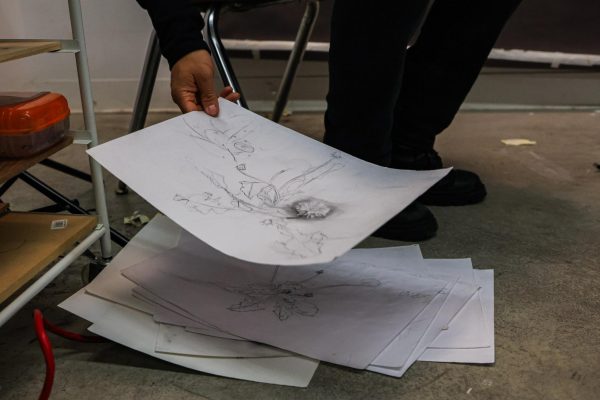
In a room overflowing with sketches and graphite stains, a drawing of two young men holding candles showcases the candid relationship between them.
“Alien,” “undocumented” and “immigrant” are a few of the words written continuously across the paper, forming into a graphite image of two boys as they look at each other.
The boys are visual depictions of University of Kentucky associate professor Daniel Esquivia Zapata and his brother as children.
“The text has to do with these definitions of who we are according to certain perspectives here in this country,” Zapata said. “We keep each other in the light, alive.”
Even today, Zapata believes they are each other’s reminder that light in this world persists amongst adversity.
Art as visual language
As an undergraduate studying studio art, Zapata said his college experience was “life-changing.”
Through encouragement from his parents and faculty, Zapata said he was able to pursue a career outside his home country of Colombia, an opportunity that would allow him to grow as an artist.
“They had a lot of hope,” Zapata said. “They didn’t know if this was going to work, but they supported me.”
Even through doubt, Zapata said his determination drove him to achieve a full ride to Benedict College, a historically Black college, where he graduated at 19 years old.
During his college years, Zapata received financial support from both his mother and a composer who facilitated the completion of his Master’s in Fine Arts degree.
Tyrone Jeter, Zapata’s college mentor and figurative artist, provided him with a different type of support, one of emotional encouragement.
According to Zapata, Jeter became a figure that helped him navigate his relationship with art and refine his passion for it.
“It saved my future, in a way. I found in him someone that would believe in me, even if I didn’t believe in myself,” Zapata said. “I could see options through his faith because I couldn’t see them through my own.”
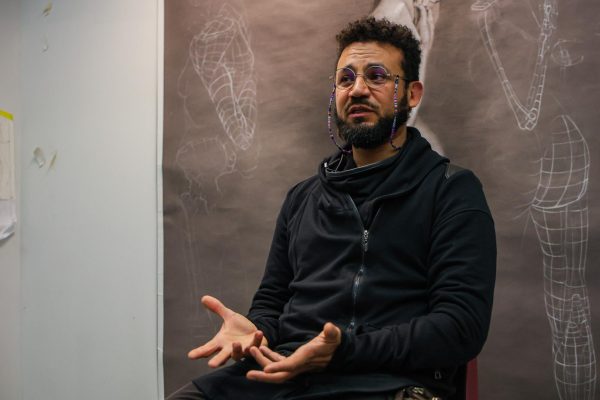
After earning his MFA from the New York Academy of Art, Zapata said he returned to Colombia, where he taught a wide range of collegiate drawing courses for 10 years.
As an Afro-Latino, Zapata said he faced racism in Colombia, something that eventually motivated him to channel his feelings through drawings.
For Zapata, language and culture are interconnected aspects that deepen his relationship with his Colombian roots, an identity he explores through art.
“The kind of stories you’re telling about, the reasons why you’re doing it, how you’re showing those people has a lot of language regarding dignity, value or anything else that can be explored,” Zapata said.
Besides expression and creativity, Zapata said he considers art as an outlet to explain and grapple with different components of life, including the “complexity” of familial relationships.
“I aspire to make these metaphors regarding what memory is, what it is to remember,” Zapata said. “So that beyond creativity and all, I explain what happened.”
According to Zapata, line drawings allow him to understand and focus on his subject of study closely, whether that is capturing the form of hummingbird wings or tracing human anatomy with graphite pencils.
Although Zapata said he originally preferred mediums like drawing due to its “monochromatic feeling,” he now also experiments with materials such as Mylar and ink to construct narratives and layering of visual stories, which he displays in his art studio.
“My favorite thing to draw is space,” Zapata said. “In a certain way, art helps me a lot to keep myself sane, alive and encouraged.”
According to Zapata, he hopes to think of art beyond its expression and explore various metaphors and ideas, such as the purpose of humans and their role in society.
In his studio, Zapata has several motivational messages spread across the walls, such as “Remember your horizons, return to them,” “Certainty is dogma” and “Double your mistakes.”
“These are my little reminders of keeping things more real for myself,” Zapata said.
“Until dignity becomes a custom”
Although his art showcases a collection of line drawings and sketches, Zapata’s political artwork, displayed mostly in murals, depicts the struggles of the Latin American community.
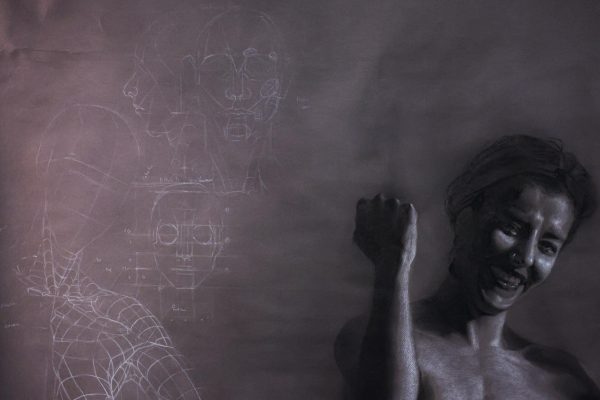
“A lot of the work has come out as a matter of exploring that invisibility and erasure, but also dignity and presence,” Zapata said.
Zapata, who grew up in Colombia at the time of socio-political conflict, said his upbringing exposed him to the violence that ultimately led him to work with victims of war.
As a way to react to the social injustice occurring during his teaching career in Colombia, Zapata said he crafted collaborative murals outside the Universidad Pedagógica Nacional.
According to Zapata, the murals showcased nine victims of political violence through individual portraits that included text to accompany their life story, saying amongst the victims were graduates, community leaders and teachers who had been killed for their intellectual ideas.
“The language of the mural became part of these efforts to build up memory, peace, remembrance and giving dignity,” Zapata said.
According to Zapata, the portrait’s inauguration was led by the message: “Until dignity becomes a custom.”
For Zapata, the motto not only served as historical memory, but also encouraged family and friends of the victims to gather and commemorate the life of their loved ones.
“They (the victims’ family members) stood in front of the mural, held hands and screamed because of their death,” Zapata said. “They will never stop looking for the truth.”
Artistic guidance and instruction
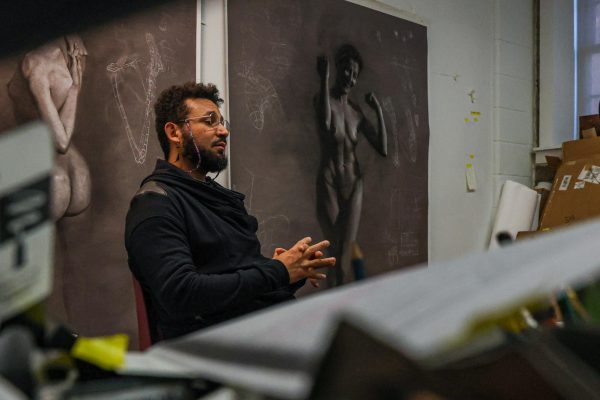
Now an assistant professor of foundations and drawing at UK, Zapata said he examines his students’ work and encourages them to explore themes along their creative process.
For Zapata, pointing out areas of improvement within his students’ mediums allows him to express his faith in them.
“You see people grow,” Zapata said. “They change, they expand, they flourish a lot.”
According to Zapata, showing his students sketches from his freshman year of college helps them understand that artists need to study often, and that art does not always come naturally.
Even as an artistic mentor, Zapata said he is constantly growing and learning from his own students and believes explaining concepts to them deepens his own knowledge about techniques and the development of ideas.
“If you’re facilitating a class like that, you’re exploring different ideas that each mind is thinking of,” Zapata said. “That allows you to be constantly fed by other kinds of inquiry that people have.”
For Zapata, his artistic career ignites curiosity about life and a desire to seek answers about humanity.
“Being able to use visual language as that way of exploring and understanding things, that helped me a lot,” Zapata said. “I have skills right there that I can use to make drawings of things that I need to be able to explore or understand more.”




John • Nov 19, 2025 at 9:49 pm
Check your spelling on the tag and on Instagram, Columbia isn’t a country….