


























































































































































It begins with a length of branch about a foot long and a few inches thick, cradled in calloused hands. With a sharp crack, an axe splits the log cleanly down the middle, creating a blank canvas.
With the light touch of a pencil, the faint outline of a spoon is sketched across the log’s flat surface. The same axe then carefully chops away at the excess wood, each strike letting the imagined form gradually take shape. Slivers of wood curl and fall, littering the floor like wooden confetti.
Once a rough shape of the spoon appears, a carving knife is used to refine the design with slow, smooth movements. Gradually, the carving knife refines curves, rounds harsh edges and breathes life into the wood.
Then comes the hook knife, its wooden handle smooth to the touch from years of use. The curved edge of the blade reaches where the carving knife cannot, hollowing out the spoon’s bowl.
To finish the age-old process, the carved spoon is gently rubbed with mineral oil, and a final burnishing smooths the surface to a silky sheen.
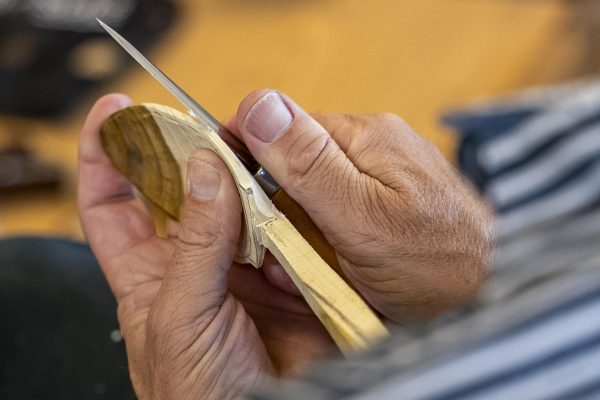
For Transylvania University professor Kurt Gohde, the traditional practice of carving with hand tools, known as “green woodworking,” has become not only a cherished pastime he shares with his students but also the source of inspiration for many of his projects.
Originally from rural upstate New York, Gohde earned his Master of Fine Arts in sculpture from Syracuse University in 1998. For more than 27 years, he has taught sculpture, photography and video at Transy.
Although Gohde had always been passionate about woodworking, he did not discover spoon carving or the green woodworking movement until 2020 during the COVID-19 pandemic, when he said he had to adapt a sculpture class for remote teaching.
According to Gohde, it was not until two years after he started teaching spoon carving that he completed his first spoon and began pursuing carving as his own art form.
“Finishing the first spoon made it all feel very different,” Gohde said. “By that point, I had sort of already started to connect with a growing international movement of green woodworkers.”
Since becoming involved in the green woodworking movement, Gohde has attended numerous carving festivals, traveling as far as England to learn about the history behind the art form.
At these gatherings, Gohde says green woodworkers from around the world come together to celebrate and practice traditional woodworking techniques that rely on freshly cut, or “green” wood and simple hand tools.
“Once I sort of connected with that movement, things felt very different,” Gohde said.
However, it was not until a black maple tree fell at Henry Clay’s estate in Ashland, Kentucky, that Gohde said he got the idea for what would later become his “Witness Tree Spoon Museum.”
According to Gohde, a witness tree is a tree that stood during a significant historical event, silently “witnessing” history as it unfolded. Gohde said these trees that serve as living connections between the past and present are what inspired his woodworking.

While collecting wood from the black maple that fell on the estate, Gohde said he learned from a groundsperson that many of the trees were planted by Clay himself.
“That made me realize how interesting it was that I could make something with wood that knew Henry Clay,” Gohde said.
From there, Gohde said he started to think of people he found interesting as a young person and how he could source wood from trees that had witnessed their lives.
“The first person I reached out to was a person who was currently living on the property where Allen Ginsberg lived,” Gohde said. “He’s a beat poet. He lived in upstate New York, and that property was very close to where I grew up.”
After carving his first spoon from wood connected to Ginsberg, Gohde said he then got the idea to link the spoons to the imaginary experience of having coffee with those individuals by using his spoons as coffee scoops.
“With this project, I’ve been trying to find authors and people that are interesting in the past to speak to all interests,” Gohde said. “There’s value in connecting to everyone’s interests.”
For the past few years, Gohde has carved about 40 spoons using trees that witnessed the lives of famous authors such as Flannery O’Connor, Shirley Jackson and Robert Frost.
Gohde said he hopes to partner with a local coffee shop in the future to sell coffee brewed using his handcrafted spoons, with each spoon thoughtfully matched to a particular roast, creating a unique experience where every element, from the coffee to the spoon, is tied to a specific historical figure.
While the coffee project is still about a year away, according to Gohde, his witness tree spoons, along with other hand-carved pieces, were featured in an exhibition at the Pam Miller Downtown Arts Center.
The exhibition, titled “Forest Bathing,” ran from April 11 to June 7 and was inspired by the Japanese concept of “Shinrin-yoku,” he said.
“It’s a word and a concept that you can kind of cleanse yourself from political and personal things by spending time in the forest,” Gohde said. “That’s really where this project is most closely connected to.”
Lewis Honors College lecturer Jena Seiler said she was already familiar with Gohde’s work when she attended the exhibition, having previously met him at an art conference in Atlanta, where they both presented on the same panel.
“There’s something really beautiful about the tactile part of it (the exhibition). You get to hold it, you get to engage with it while you’re hearing all these stories and information about the wood itself,” Seiler said. “It subtly kind of invites you into thinking about your everyday life and where we put meaning on things.”
According to Seiler, the exhibition was powerful and encouraged her to think about her relationship with the natural world.

“Art has this ability to bring us into complex issues in a way that I think sometimes can be intimidating or it can be jarring,” Seiler said. “But it can also be engaging and fun and bring us closer to an issue.”
Gohde said he is also working on a project featuring witness tree spoons connected to Clay, titled “Compromise Spoons,” in reference to Clay’s reputation as the “Great Compromiser.”
According to Gohde, Clay’s talent for compromise helped delay the Civil War just long enough for the North to “build up its strength.”
Inspired by Clay’s legacy, Gohde said he intends to craft spoons from wood gathered at Clay’s estate and send them to political leaders in the hopes of encouraging compromise.
“Those will be spoons that are made not as coffee spoons, but as compromise spoons and sent to people in the federal government that would benefit the world perhaps on issues of social justice if they were able to compromise with each other,” Gohde said.
According to Gohde, spoon carving has also helped him foster community with his students through a carving circle he hosts in his studio every Wednesday afternoon.
There, in his classroom, Gohde said students practice their carving skills while having meaningful conversations that do not typically happen in a classroom setting.
“We end up in that carving circle being able to talk about the sort of things that students, I feel like, need to talk about,” Gohde said.
According to Gohde, although many of these conversations are political due to “the nature of today’s world,” his students often find relief in the simple act of working with wood, an experience he believes lies at the heart of green woodworking.
“Historically, it (spoon carving) would be someone sitting on their porch doing this thing by themselves as the world passes by,” Gohde said. “But it’s become something that is very much a community builder for me and that’s been great and exciting.”