





















































































































































The University of Kentucky and the Mexican-based theatrical company La Coperacha presented “Títeres al Baile,” or “Puppets to the Dance,” a performance telling different stories of death through a cultural lens.
The performance took place at the Otis A. Singletary Center on Saturday, Nov. 8, and combined elements of contemporary music and puppetry.
Antonio Camacho, the stage director for the performance and founder of La Coperacha, established the group 46 years ago in Guadalajara, Mexico, where the company is based.
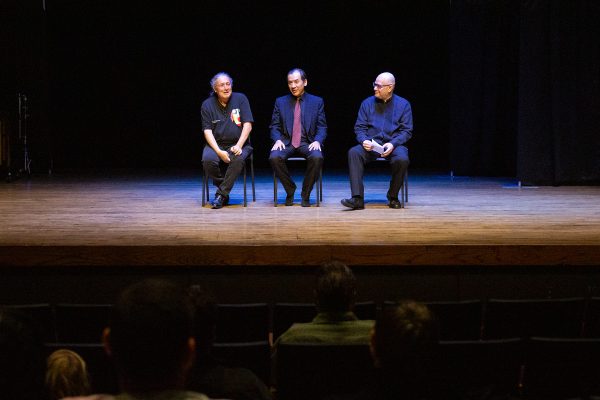
The show’s name can be translated as “Puppets to the Dance,” and it displays themes of love, destruction and nature, according to Camacho, as well as Mexico’s views on death and its relationship with its people.
“It’s a big challenge to produce this music and the script to the stage, and besides, death is so tragic, it’s a tragedy,” Camacho said via Alejandro Herrera translating to English. “To play with this and taking to something like not funny, but something very close to play when it’s very tragic to speak about death.”
Artist Miguel Ángel López made the puppets featured in the production which loosely resembled a type of two-dimensional toy that represents death in Hispanic culture, Camacho said.
Alejandro Herrera, an actor and puppeteer in the show, said he has done around 20 different shows featuring puppetry and has been with the company for 18 years.
“I have fun normally working with puppets, for example, I am like a child, I see a puppet and I immediately take them and start moving it and telling jokes and telling a short story or something,” Herrera said. “To work with puppets. I think it’s my favorite aspect of all of the plays I do in my career.”
Narciso Sánchez, the production’s choreographer, has worked with the company for seven years and played the main character of “Death” at this year’s show.
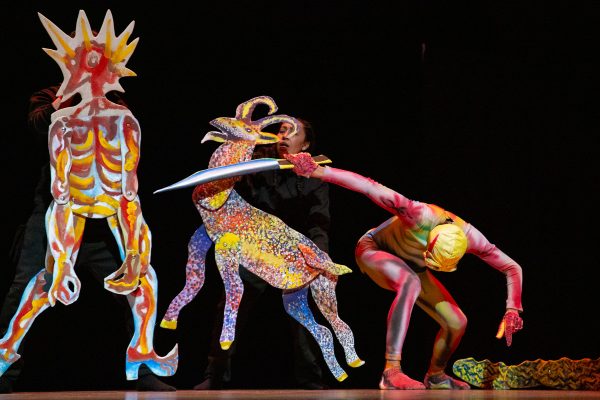
“It’s a big challenge (dancing in the production and choreographing),” Sánchez said via Alejandro Herrera translating to English. “I am very thankful because I love the process, and I am still a dancer. I have been a dancer for 40 years.”
The show’s composer and music director, Juan Trigos, is a professor of music composition at UK and is in charge of the UK new music ensemble.
Most of the show’s segments were written with the dodecaphonic technique in mind, Trigos said, which means specific notes can’t be repeated until the end of the play.
“Every time that C (the note) is very pronounced, then is the death, and that’s the main character,” Trigos said. “Every time you have the death, you have that chord and all the rest is all the variations of that small motif that represents what we are listening.”
Ensemble member Daniel Monroy played classical guitar in the show and is a final-year doctorate student in musical arts at UK.
Monroy said this was an “amazing show” to play in an ensemble, giving him a chance to collaborate with others and follow a conductor.
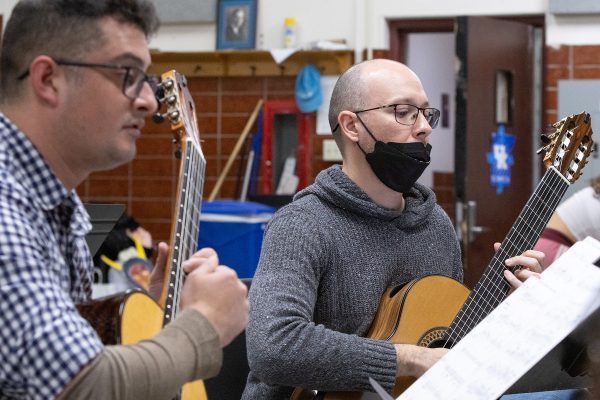
“When we started playing in the new music ensemble, it was very hard, and it was a big challenge, and still is a challenge because it’s contemporary music,” Monroy said. “The language is different … So for me, it’s really important, because I want to be in this profession forever, until my last day.”
The show has a “profound meaning,” according to Monroy, who said during moments in the score where there are seemingly random sounds, connections are being made between the music, puppets and dancers.
“It’s beautiful, you need to be into this and practice a lot. It’s like, you need to listen to a lot of this music to start finding the uniqueness in it,” Monroy said.
Grant Johnson, a first-year master’s student in musical performance, attended to watch a friend who was in the ensemble. He said he really enjoyed the show, coming in with little knowledge of what it was about.
“I can’t think of the right word to say. I would just say bizarre, but in all the right ways. There’s so many different puppets and just styles of music and stuff that was being played,” Johnson said. “It’s really a great representation of new music. I was there for the music, but the acting and theatrical aspect of it was great.”