















































































































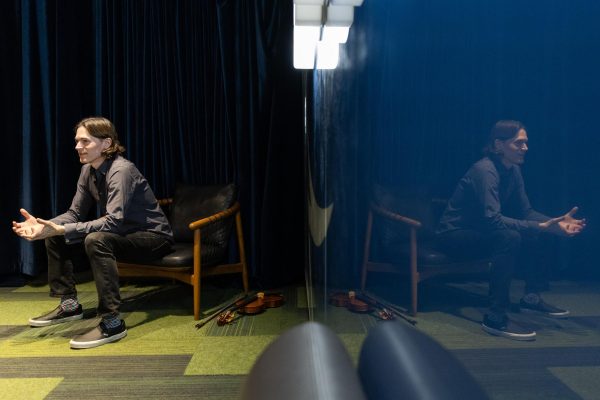
As the sunset blurs the afternoon away, the gentle hums of a violin duet the whistle of the espresso machine.
People sit back comfortably and close their eyes as they let the violin’s wand enchant them with the spell of soft melodies.
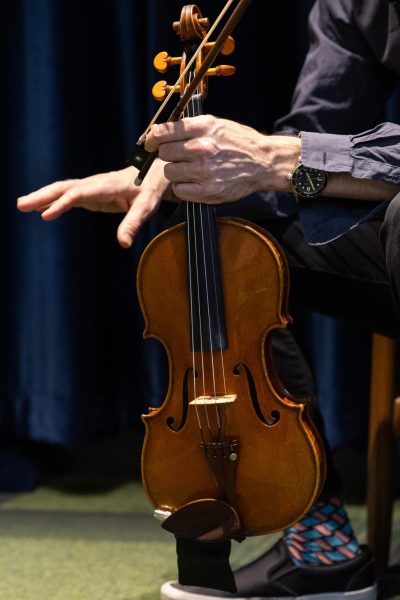
The lights of Kenwick Table dim to adorn the man with a luminous halo, spotlighting him and his wooden instrument.
The man is Zach Brock, Grammy-winning violinist and life-long musician.
Musical beginnings
Growing up, Brock remembers his childhood being filled with figures that influenced his encounter and gradual passion for music.
His mother, a classical soprano, and father, a jazz and folk music enthusiast, met singing in The Lexington Singers, a group welcoming all musical talent.
In addition to starting formal violin training at the age of four, Brock also sang in the local Christ Church men and boys choir, listening to his voice echo off the marble from the cathedral.
“I think most of the memories I have of music involve participation,” Brock said.
According to Brock, sitting around in his family band’s circle and attending jam sessions were some of the experiences that introduced him to the world of music creation.
“I feel like when I got a message like that, got encouragement like that, it just fueled a fire in me,” Brock said. “I became like a guided missile for information.”
Aside from the direct exposure to music he received from his family, Alfalfa’s, a local Lexington restaurant during Brock’s childhood, fostered a local community of talent for him.
According to Brock, artists ranging from music faculty to string quartets would showcase their art with a welcoming audience filling up the restaurant.
For Brock, learning skills like improvisation expanded his knowledge on the craft of what music could become.
“When I was studying Suzuki violin I was learning how to play a piece with the right notes and I wasn’t taking liberties, I wasn’t inventing my own stuff,” Brock said.
At age 13 and 14, Brock participated in an exchange program over the summer where he flew to Paris and deepened his relationship to music.
“I love being in places I don’t understand. A lot of my drive for a career in music was because I saw it as kind of a musical passport,” Brock said. “It changed my life completely.”
Education in the arts
After graduating from Bryan Station High School, Brock continued to cultivate his passion for music and pursue a classical degree in violin performance at Northwestern University.
For Brock, an education in the arts became a vital part of his musical and learning acquisition. Despite his background in conventional instruction, he believes music can coexist as both an institutional and community learning experience.
According to Brock, communal educational experiences in his life included going to folk group during his childhood as well as playing gigs in a band.
“Your teacher ultimately is the person that teaches you how to teach yourself,” Brock said. “You very rarely come out of high school having figured out how to teach yourself to get better.”
Even now, Brock applies what he learned as an undergraduate majoring in violin performance and gives himself assignments, like scheduling lessons with himself, and challenges, including self-critique, to complete during practice.
Although his musical heroes include renowned figures of the musical scene such as Itzhak Perlman and Jean-Luc Ponty, Brock remembers those who have impacted his life in closer proximity, including his college professor, Myron Kartman, and his father’s drummer, Norman Higgins.
“He’s (Higgins) the guy that taught me how to swing and showed me how to listen to know if I was swinging or not,” Brock said. “He enabled me to just have full unqualified confidence that at the very least I could swing.”
After college, Brock moved to Chicago hoping to gain experience and immerse himself in opportunities like attending jazz workshops and camps that would better his craft in classical music.
One of the intensive workshops he attended took place at The Kennedy Center, where he received the Betty Carter Jazz Ahead Scholarship that sponsored his participation in the jazz program.
According to Brock, the opportunity to partake in such a workshop allowed him to perform with his band and branch out to produce his own records.
“That’s really when my career started, when I started to putting together my own tours and learning about all that music business stuff,” Brock said.
‘You have to master yourself’
After some time in the Chicago scene, Brock felt like he had to move to the universe of the music he loved: New York.
“I never thought that I ever wanted to live in New York until I woke up one day and said, ‘I can’t live with myself unless I move to New York because I just won’t know.’ I can’t stand not knowing,” Brock said.
Within a couple of years after his moving, Brock joined Snarky Puppy, a multi-Grammy-winning American jazz band with over 20 members belonging to different parts of the world.
According to Brock, his incorporation into the group started with him being the opening set for them at a club once.
“Three of the members of the band kind of backed me up on my turns and then all of a sudden I was on the road with Snarky Puppy,” Brock said. “Now that band is kind of my main thing.”
Throughout the years of touring with Snarky Puppy, Brock understands that practices like consistency and getting in the right headspace before a performance can be hard to manage.
“I think that what you realize as you’re trying to master the art of performance is that really what you have to master is you have to master yourself,” Brock said.
For Brock, the thrill of travel comes with the benefit of connecting and exchanging energy with the audience he’s playing for, allowing him to listen to the music he’s producing.
“You do get spoiled when you go on tour. You go into a space and people are hungry for your music, you know?” Brock said. “That is amazing, almost an addictive feeling.”
Even through years of experience, the mental aspect that goes into a performance weighed heavily on Brock, causing him to seek practices easing his distress before a show.
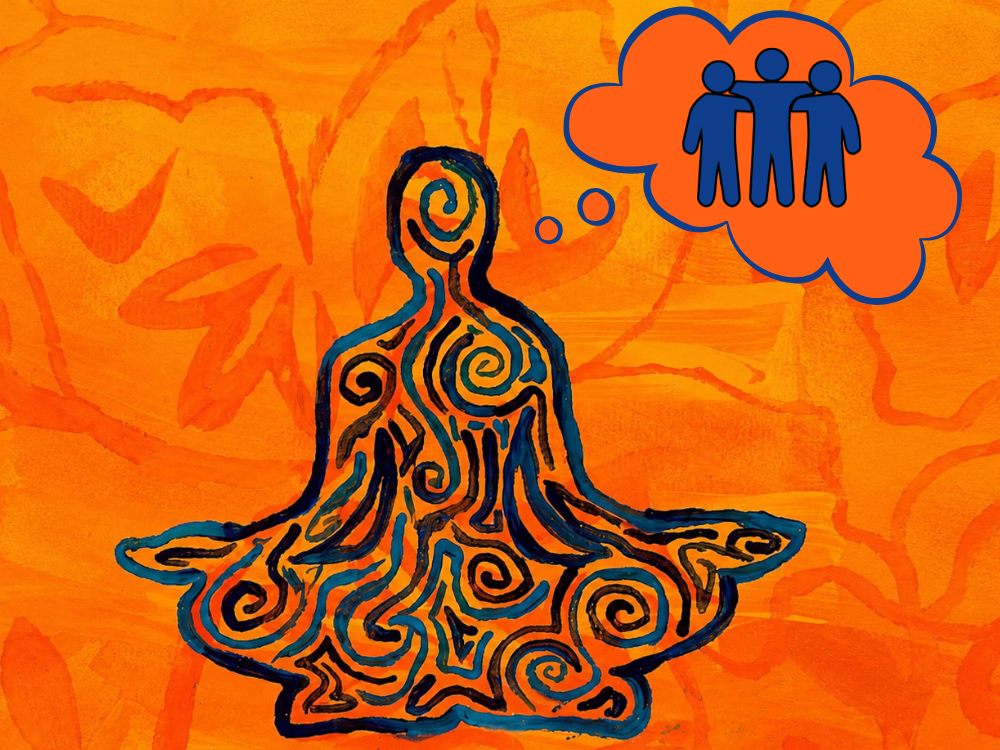
“Meditation is kind of like playing scales for your brain,” Brock said.
Before implementing mindfulness into his pre-show routine, Brock faced challenges along the way of composing compelling tunes, including dealing with the expense of saying yes to every gig.
“There are times when it definitely feels like a curse. You’re in so deep that there’s not really anything else you can do anymore,” Brock said. “But I’ve never fallen out of love with music, I just fall out of love with the grind.”
According to Brock, burnout can be part of the tiresome and unproductive routine that becomes hustling.
During his early days making records, Brock realized the weight resources such as time, money and energy carry.
“The whole saying ‘you gotta spend money to make money’ is one of the most poisonous, destructive, crippling things that you can take on,” Brock said.
Over time, Brock has developed an understanding that the idea of artistry can exist within entertainment. Alterations to a piece as subtle as modifying melodies can change the course of a performance.
“In a perfect performance, you are aware of everything and touched by nothing. Almost like you’re a passenger,” Brock said. “The best performances are when you don’t try.”
The art of practice
Through his years as a performer, Brock recognizes concentration and discipline are aspects that deeply influence his preparation to deliver musically.
“I’m striving to be a lake with no ripples,” Brock said. “I’m still trying to let the water get flat before I start playing.”
During a session, Brock concentrates on hearing the texture of the notes he’s playing as a way to facilitate kinship with any given piece.
For Brock, engaging in a peak or flow experience allows him to diversify and better his craft as a musician.
“You approach or get into these flow states that are kind of beyond what you think you’re able to do, almost like you’re being played rather than you’re playing,” Brock said.
For Brock, attending a recital once led by violinist Maxim Vengerov has been one of the most intimate, rawest ways to experience the sound of a violin.
“I felt after I left that recital that my violin game had leveled up like five levels by being there,” Brock said. “I didn’t feel like ‘oh man, I’m never going to even come close to that’”.
According to Brock, experiences like these can happen a few times throughout an individual’s life, amplifying their existing talent and marking their artistic journey forever.
Balancing passion with life
For Brock, moving back to Kentucky represented more than just reconnecting with his roots, the ones that started it all. It meant his kids could have the opportunity to attend Community Montessori School, like he once did.
“I think you know what’s home when you realize that where you are based gives you a source of strength,” Brock said.
For Brock, connectivity to the simplicity of his original tune “Almost Never Was” has only grown over the years, reminding him of Kentucky.
“I went to my mom’s piano and came up with this little melody that just kind of repeats,” Brock said. “It’s almost sort of like a hymn that you would hear in a country church.”
Although time has passed between the present and the hustle of gigs in the past, Brock continues to remember the opportunities he’s had throughout his journey, which have amounted to his current state of mindfulness.
“When you have an experience like that (identifying with his home), you start to see where you grew up, not for what it didn’t offer you, but for everything it did offer you,” Brock said.