












































































































































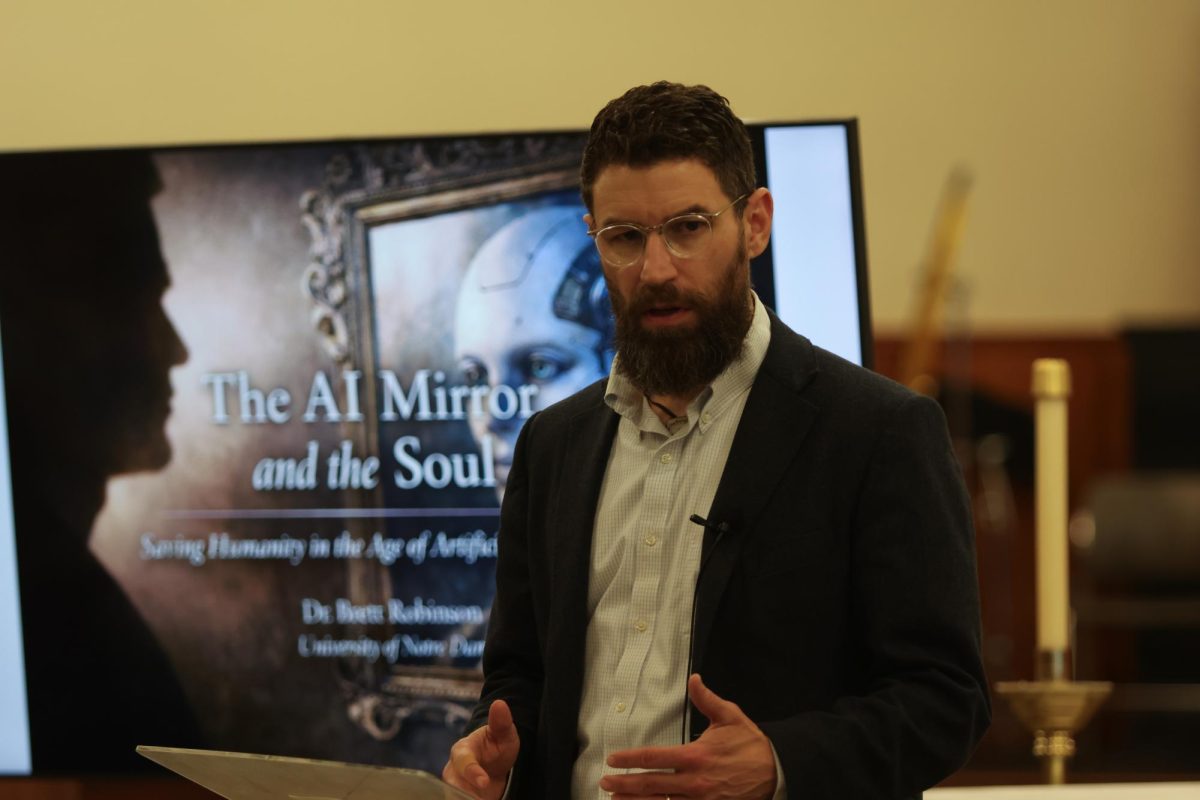
Dozens of students packed into the sanctuary of the Holy Spirit Parish Catholic Newman Center to listen to a University of Notre Dame professor talk about the relationship between Christianity, artificial intelligence and how Christians need to know what is Christ-like.
The Holy Spirit Parish hosted the event “Christianity in the Age of AI” on March 10.

(Holly Netzley)
“The lifeless machinery of digital culture is concealed by the substitution of machine learning for human learning,” University of Notre Dame priest and professor Brett Robinson said. “It’s the very thing that distinguishes us from the rest of creation.”
Robinson said humanity’s relationship with AI and more broadly technology is like using a furnace versus a fireplace. He said the results are the same but the relationality for one is far more meaningful.
“The fire becomes a symbol of the family laboring together,” Robinson said. “Enjoying the fruits of their labor and reminding us of our relationship with nature. The elements of the earth needed to fuel the fire, the natural element of fire itself, entices the imagination to find shapes in the flames to see the stories they tell.”
Liturgical acts or acts of worship are a reminder creation is not a matter to be explained for Christian’s comfort, Robinson said. He said technology risks becoming anti-liturgical.
Robinson said the furnace also comes from the elements of the earth needed for construction. But all of these are hidden from humanity’s view and don’t add to Christian’s sense of meaning, reducing the world to a resource.
Robinson said people live in a tension between the convenient results of technology and the background threat of losing connection between people. He said AI is not just a thing, it is part of a much larger story.
“We begin to see ourselves in machine terms as consumers,” Robinson said. “Copious amounts of information to optimize our human experience so we begin to predict our future outcomes.”

(Holly Netzley)
Robinson said Christians can’t compute the meaning of life because it has already been revealed through God. He said when people have purely digital exchanges, they lose something human and the more people engage with this technology the more they get locked into what they want to hear.
“Like the proverbial frog who doesn’t realize the water is creeping towards a boil, the user does not realize the choices are gradually narrowing and squeezing,” Robinson said.
Benjamin Carey, a sophomore computer science and mathematics major, said he has only used AI when he has been required to use it for a class.
“Artificial intelligence is a very advanced statistical model that takes numerical data as input and generates numerical data as outputs,” Carey said. “But AI companies are committing some of the biggest copyright scandals of all time.”
Carey said he has been in situations where he has been challenged by something which is intellectually and emotionally difficult, but he can almost feel like he physically grows when he accomplishes something extremely difficult. He said when people go to the gym they don’t have someone lifting weights for you.
“So many people are forgetting the joy of learning,” Carey said. “There is something profound about learning to share knowledge and share God’s love and creation.”