















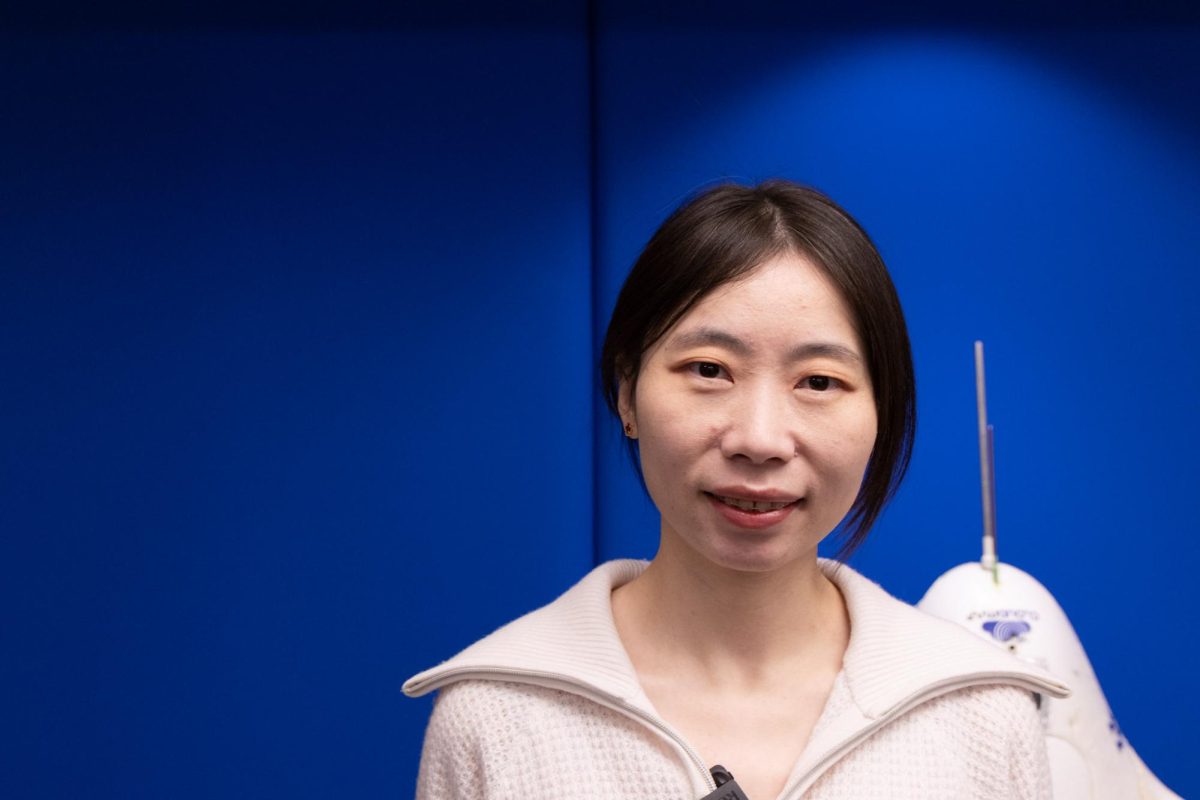


















































































































































For Biyun Xie, robots are not just a toy. They represent a real-life project aimed at creating a safer society.
Growing up, Xie said she fell in love with Japanese cartoons featuring robots and hoped to one day create her own, just like she saw on screen.
However, it was not until years later that Xie’s work in robotics truly began.
“I remember when I was a junior student at college, and I had an opportunity to join a research lab,” Xie said. “I started my journey in robotics from that lab.”
Now an assistant professor in the Department of Electrical and Computer Engineering at the University of Kentucky, Xie researches robotic arms and how they move – a project she began as a doctoral student.
While earning her Ph.D. in electrical and mechanical engineering, Xie researched fault-tolerant robots, focusing on enabling them to keep working toward their goal, even after mechanical failure.
“If the robotic arm needs to pick up something and place it at another position, then we need to find a feasible trajectory to make sure it can avoid the collisions with the surrounding environments,” Xie said.
Robots can access harsh and hazardous environments such as outer space, nuclear waste sites and disaster rescue missions that are typically inaccessible for humans, according to Xie.
“I think daily assistance, such as the human-robot interaction and the social robots … is very important,” Xie said. “Because during the human-robot interaction, safety is a very critical feature we need to consider.”
Not only does Xie conduct her own research, but she also teaches doctoral and high school students, something she says gives her a sense of hope for younger generations.
“When they develop a new algorithm, and when they test it and it works, we are so happy and we are so excited about these kinds of breakthrough results,” Xie said. “I think I’m very proud of my students.”
Xie hopes her research continues to expand beyond robotic arms, saying human interaction is important to robots’ understanding of both emotion and intention.
“We would like to develop more helpful and useful robots for different kinds of applications,” Xie said. “You can use a collaborative robot to collaborate with human workers for some assembling tasks, so we can improve efficiency.”

