





















































































































































As students walk the narrow and trafficked sidewalks, some may see the various lawn signs scattered across campus, while others may never bat an eye.
Unexpectedly, for Caylin Kohlstruk, a junior English and writing, rhetoric and digital studies major at the University of Kentucky, seeing a cardboard sign that said, “Grief Sucks,” meant taking a chance on something that would later become an overwhelming blessing.
Similarly, senior Caroline Cygan, a neuroscience major on the pre-physician assistant track, said she hopes to amplify student voices by being a driving force to expand a formal grief policy unseen before at the University of Kentucky.

Both students have been impacted immensely by grief, with Kohlstruk’s mom passing away due to a stroke 10 years ago and Cygan’s brother passing away due to epilepsy in 2022.
Both are working cohesively to help grieving students find their voice and provide more access to life-changing resources, something the university largely lacks.
For Kohlstruk, being a peer leader for the eight-week-long Loss Inspiring New Connections Program (LINC) has been nothing short of a blessing.
Going through LINC herself, Kohlstruk said the experience was a bit nerve-racking at first. She said she felt the stigma within herself and the difficulties of understanding what was normal.
“I was kind of embarrassed to go and be talking to these people. It’s like ‘Oh well, she died 10 years ago. Why am I not over that?’ But when I went, it was nothing like that at all. Nobody judged me,” Kohlstruk said.
Cygan, while not going through the LINC program herself, has had her own sessions with other support groups similar to LINC to help with her grief. However, it is the student advocacy and making sure students have access to better resources that inspires her.
“My brother didn’t get to graduate. He didn’t get to walk across the stage. Things have just really hit hard for me, and I was thinking, ‘How can I give back and help people that are also dealing with this?’” Cygan said.
Cygan, when talking about the upcoming project being presented to the Student Government Association, said the main message regarding her team’s project is advocating for students’ needs in terms of grief.
Whether that be raising more awareness, or making it easier for students to receive academic accommodations when periods of grief become increasingly prominent.
While being strong advocates for UK students, both Kohlstruk and Cygan agree that there needs to be change, especially to make sure students’ needs around grief are being intentionally listened to rather than just being swept under the rug.
“There’s just a major lack of emotional intelligence about it,” Cygan said. “And that’s why for me, specifically, I want to go into healthcare, because I think treating patients with emotional intelligence and actively listening to them is super important.”
Navigating college and the stressors that come with it is tough, overwhelming and grueling. However, navigating the tribulations of grief on top of that poses even more difficulties that some peers and professors fail to understand and empathize with, Cygan said.
“It feels like you’ve been through this one life-altering event, and you just don’t connect with people that have never gone through that, and don’t understand. It’s just really difficult,” Cygan said.
Kohlstruk said the stigma is still there with other people reinforcing it by saying, “It’s been six months, why are you still on it. It was just your grandma.”
Facing the same attitudes from peers and professors, Cygan said, people fail to realize how mentally taxing and how much grief can weigh on you. Additionally, they fail to realize that death is not just a one-time event, and it’s something people can heal from.
Because of this, Cygan is passionate about giving back to students, hoping she is able to provide the means to help grieving students heal.
Cygan touched on people’s judgment and lack of empathy and said, “It’s like move on, you know, you can’t let it drag you down. It’s not that people feel like it’s dragging them down, it’s just that they want to be validated.”
( Xavier Patterson)
Kohlstruk talked about her own feelings with grief and mentioned the LINC was a huge help.
“When you’re grieving, one of the biggest struggles is feeling like other people don’t understand, and it can feel really isolating. But I guess the direct reward of going in and just ripping the bandaid off is that you go in and immediately are like these people kind of get it,” Kohlstruk said.
From her own experience, Kohlstruk said she believes it is essential for people who grieve to “be selfish.” She said, “It’s really easy to escape into other people, but it’s a really individual process. It is so important to be selfish and know that what you are feeling about yourself is the most important thing. It matters more than anybody else telling you that you should be over it by now.”
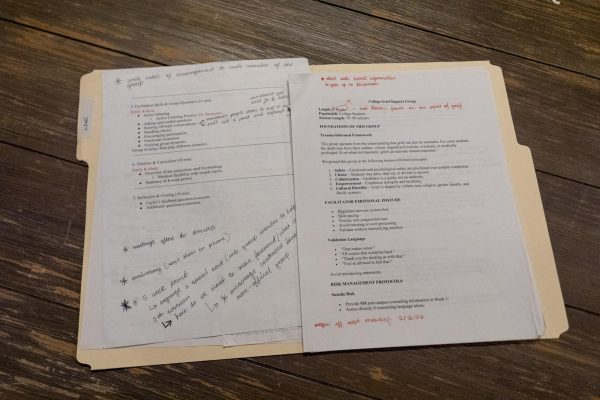
Aiding students in problem solving, setting boundaries and connecting with their emotions is a main goal Kohlstruk implemented when leading LINC. She also said changing the mental narrative students tell themselves is an integral part of healing.
“If you go about your day just kind of deciding what to think, just kind of following the ebbs and flows of your thoughts, you miss out on so many opportunities to learn about other people and yourself, too,” Kohlstruk said.
However, Cygan also said students facing grief should also feel free to fully feel it all. She mentioned she reached a point in her grief where pretending that everything was fine meant that she was lying to herself. She said she felt ‘discombobulated,’ and felt that she was stuck within this traumatic event while those around her were perfectly fine.
“Not a lot of people feel like they can integrate it into their lives. They feel like it’s this elephant in the room, and like it’s this big dark cloud that just won’t ever go away,” Cygan said.
Cygan, spearheading this SGA effort with two other students and professors, hopes to help grieving students by having the University implement academic accommodations, excused absences, exam accommodations like private rooms for tests, and extensions for exams or assignments.
Another effort Cygan hopes for is to get staff equipped and trained on how to handle these situations, understanding how it impacts students on a personal level, with more emotional intelligence and empathy
“I think the big issue is it just feels so discouraging when you’re in your classes, and you’re told, you know, what do you need for that. You just don’t know how to feel, and there needs to be a concrete plan and resource,” Cygan said.

( Xavier Patterson)
Cygan even said there have been situations where she’s been told by the professor to provide proof of her grieving, one even asking to see an obituary as concrete proof.
“I feel like an inconvenience whenever I try to advocate for myself sometimes. I feel like the biggest issue I’ve experienced, too, is how to frame an email. Because you feel like you have to overcompensate and overexplain every single detail for them to understand,” Cygan said.
While grief may seem simple, the misconceptions surrounding it make it even more complex.
“The biggest misconception with grief and grieving in general is that it’s one singular emotion, but it’s kind of more of an umbrella term that holds all these different things within it,” Kohlstruk said.
When talking about advice she wants to give other students who may be going through the same grief as her, Cygan said, “My goal is for people to understand that this isn’t a scary thing that you can’t talk about. It should be something that kids find a meaning out of.”
Cygan said that she wants kids to find a purpose within their grief and said, “People talk about how grief sticks with you your whole life, but no one talks about how you can heal from it. Nobody talks about how you can get to the other side of it. So for me, this project is really purposeful.”
Although the campus can seem large and daunting, both of these women strive with the goal to highlight students’ needs and continue to break the unfortunate stigma around grief, one brave step at a time.
“It’s totally okay to be angry or feel guilty or obviously sad. When you’re connecting with your emotions, the point is not to solve, but it’s to identify. You don’t have to fix the feeling, you just have to understand it and get familiar with it,” Kohlstruk said.