
















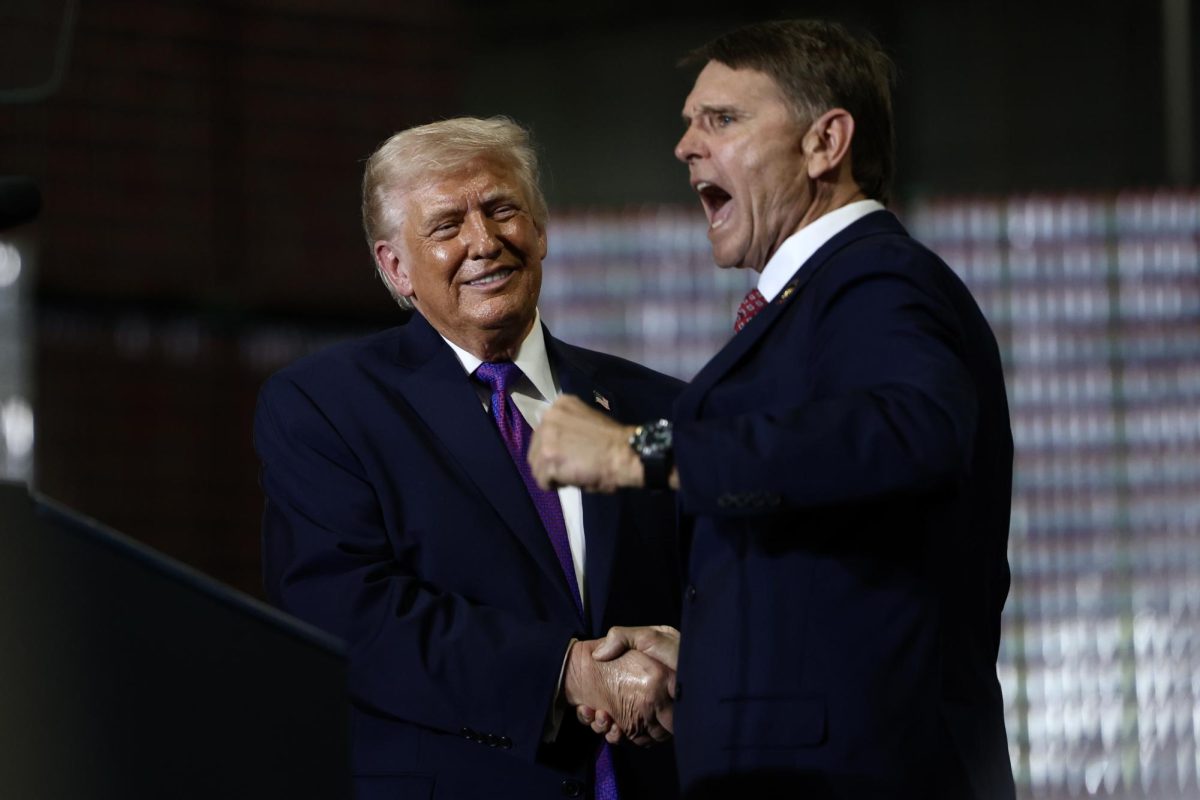












































































































Feb. 24, 2026, President Donald Trump stood before a house divided for the first State of the Union Address of his second term.
This division is reflective of rampant polarization throughout the country, with six in ten Americans reporting that the country is in a worse place now than it was a year ago. Instead of trying to bridge divides, Trump only deepened them in one of the most intense speeches of his second term.
The Republican majority frequently stood and applauded the President, often even chanting “USA.” The slight Democratic minority took a different approach: stay seated and show no reaction.
While Democrats were encouraged to stay silent, a few representatives wore pins, held signs, and shouted in protest. Notably, Representative Al Green (D-TX) was escorted out of the House Chamber after holding a sign that read “Black People Aren’t Apes.” As he was leaving, House Majority Leader Steve Scalise (R-LA) attempted to remove the sign from Green’s hands.
President Trump spared no scrutiny in his address, which became the longest State of the Union in American history. He began his speech by comparing the first year of his second term to Joe Biden’s presidency, arguing that we went from a “dead” country to the “hottest.”
He pointed at Democrats and called them “crazy,” frequently blaming Democratic party leaders for a host of issues, including immigration, healthcare and the economy.
President Trump also doubled down on his most controversial policies, including immigration enforcement, oil partnership with a broken Venezuela, DEI and tariffs. Strikingly, Republicans hesitated to applaud Trump on his section on tariffs.
Trump stood on the podium, feet away from four Supreme Court justices who struck down his tariff policies, and argued that tariffs could replace income tax.
In typical Trump fashion, the speech felt impulsive and unscripted at times. Throughout the speech, even Vice President JD Vance and Speaker Mike Johnson turned to each other and laughed at President Trump’s remarks. It seemed that Trump had three primary strategies: blaming Biden, blaming Democrats and bragging.
With midterm elections coming up in November, this may be President Trump’s last address to a Republican majority Congress. While he did not extend the olive branch to the opposing aisle this year, he may soon be forced to soften his criticism and begin working with Democrats.






Joni Farmer • Mar 6, 2026 at 1:01 pm
This is an editorial, not an unbiased report at all.