


















































































































































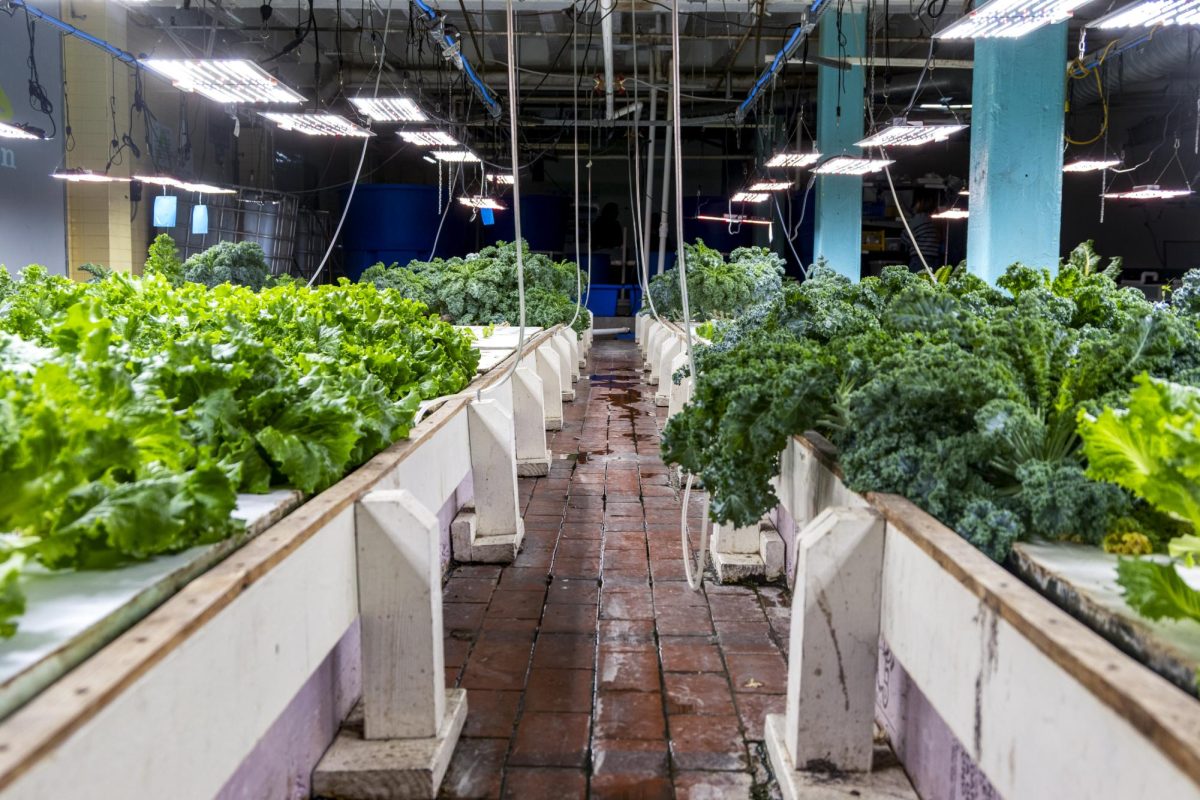
The Lexington-based nonprofit organization, FoodChain, offered a public tour of its 7,000-gallon aquaponics system at its indoor facility on Dec. 6
The tour takes place every Saturday from 1 p.m. to 2 p.m. on West 6th Street and costs $10 per person, according to their website.
FoodChain is home to the first indoor aquaponics system in Kentucky, with the mission to reach the Lexington community through education and demonstration while providing access to fresh, locally sourced food, according to their website.
Ethan Buland, aquaponics educator and farm manager at FoodChain, said aquaponics is a sustainable form of agriculture that combines hydroponics, or growing plants in a medium other than soil, and aquaculture, which is raising any kind of animal that lives in the water.
“Aquaponics, when operated properly, can be a very sustainable form of agriculture, and you can grow a lot of food in a relatively small space,” Buland said.
According to Buland, the system works by filtering water from the fish tanks into the grow beds and back to the fish tanks, where the cycle repeats in a constantly recirculating system.
“Aquaponics is one of the most water-conservative forms of agriculture out there,” Buland said. “So we’re not losing water down through the soil like you do in a lot of outdoor agriculture.”
In addition to conserving water, aquaponics allows crops to grow more quickly and in a smaller space by controlling aspects of the environment such as temperature, humidity and airflow, according to Buland.
Using this aquaponics system, FoodChain can grow and harvest tilapia and shrimp, as well as leafy greens such as lettuce and kale, which then go to Smithtown Seafood or one of their food distribution programs.

According to Buland, FoodChain is comprised of three main components — the aquaponics farm, direct education programs and the Nourish Lexington Program, which offers free meals to people experiencing food insecurity.
“The third component of FoodChain (Nourish Lexington Program) really started in 2020 when the pandemic hit,” Buland said. “At that point, not only were there more people than ever who didn’t have enough access to fresh local food at all, there were also a lot of small farmers with crops in the ground and nobody to sell them to.”
Buland said that through grant funding, FoodChain was able to purchase crops from farmers and use them in meals to distribute to people in need.
“Between all their different programs, I believe the kitchens produced something like 1.4 million some meals since 2020,” Buland said.
According to FoodChain Co-Executive Director Leandra Forman, the educational aspect of the organization is just as important as the food access.
“FoodChain focuses on food access and food security through the lens of modeling a sustainable food system with equity at its core,” Forman said. “So, we work to make sure everyone has access to food, but we also believe that you can’t just provide access without education.”
According to Forman, in addition to the public tours, FoodChain also offers food literacy classes throughout Lexington as well as educational opportunities where people can learn to grow their own food in an urban environment.
“I want people to feel like they understand the system well enough to know how they can improve on it and how they can make change in their own life, in their own community and really take ownership of it,” Forman said.